
Learning Story – The Icicle Economy
January 23, 2026
What Happened?
Welcome back, Bushkids family! We missed you all and hope your holiday was filled with rest, joy, connection with Land and family.
Today we welcomed a new friend to Bushkids and we invited a knowledge holder from Łutsël K’é – Verna Catholique to join us again and connect with the children by bringing a sense of pedagogy of surprise! Verna shared her fish from Łutsël K’é and the children were engaged, curious and investigated – Bushkids dove right in and asked about the guts, eager to cut the fish and cook the fish for everyone.
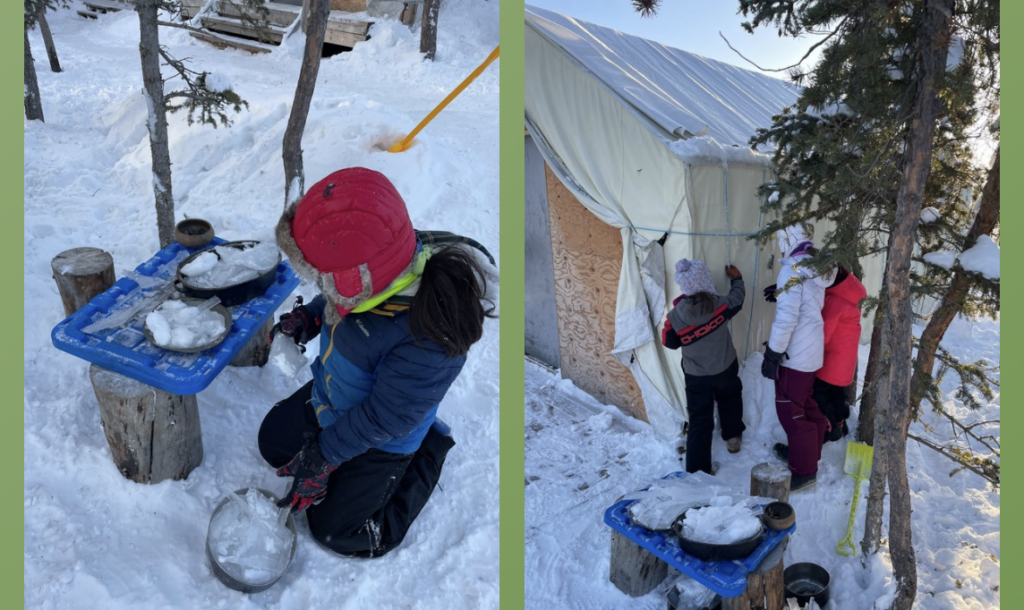
As some were spending time with Verna, some Bushkids played outside – one Bushkid planted an amazing idea of collecting icicles and creating an “icicle economy.” What started as an idea quickly turned into naturally mining icicles together. Important roles were naturally coming together, 5 Bushkids were mining icicles for 1 Bushkid’s shop and they negotiated by exchanging materials: icicles for spruce cones. Naturally working and problem solving together, eventually the idea grew bigger. Bushkids started to expand the economy in another location with tables, signs, workers and the play became a whole day of play!
Why is it Important
There is a deep sense of community when we invite knowledge holders andEelders to simply build relationships with our traditional foods and most of our childhood memories are on the Land and outside, using natural materials to create a huge empire! We become leaders of our play, children will make their own boundaries and learn problem solving skills. As educators, we observed how deeply engaged the children were and interviewed them, to better understand their thinking. The children confidently explained their roles and ideas, they demonstrated so much creativity, communication, cooperation, and early economic and mathematical thinking through meaningful, child-led play by using real life scenarios to naturally build play.
As a reference:
Dene Kede Curriculum: Fish. Pg. 91-97
The students must appreciate that fish have been one of the main food sources of food for the Dene and will continue to be. Fish therefore played a large role in the lives of the people.
Play Learning Aids. Pg. 196- 199
‘It is believed that children grow through play so when they are stopped they become sick” – Lucy Tatti, July 12, 1993
Play is a crucial developmental part of the Dene child’s development , and is essential to the acquisition of language. Through play, children find friendship, learn leadership skills, and develop mentally, physically, creatively and spiritually. Play is considered an important process for a child in need of healing. Learning how to make traditional toys is one way to learn about the past, and to gain knowledge and skills which can be passed to the next generation.
Students will learn that traditional learning aids were often models of the real thing, such as smaller versions of bows and arrows and other tools, and they will need to learn to exercise safe handling of these types of toys.
What’s Next?
Hear legends about Hacho (big giant) also known as (Yamoria): “Who was Yamoria?”
Try more traditional foods with a knowledge holder.
Open a discussion about love and kindness.
BushKids Quotes
“Can we cook the head again?” referring to fish (łue) head.
“Can we cook the tail?”
“Are the fish eggs still alive”
“I have a ice shop that sells different shape and sizes. I have 5 different people
working for me.”
“They mine ice and bring to the shop. The money is pinecones”